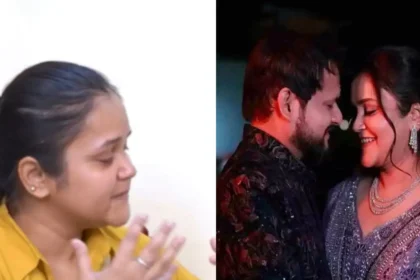
Indian actress Girija Oak Godbole, who recently became an internet sensation as the “woman in the blue saree”, has spoken candidly about the unsettling flip side of her viral fame. What started as praise for her elegance has morphed into a disturbing controversy involving AI-generated sexualized images.
The Viral Moment That Sparked It All
Oak’s surge in popularity began after an interview (with The Lallantop) where she wore a simple blue saree. In the video, she recounts a funny incident from her college days — her physics professor mispronouncing “waves” as “babes.”
Netizens went into a frenzy. While many praised her grace, some social media pages began sexualizing her image. She’s even been compared to Hollywood actress Sydney Sweeney and Italian supermodel Monica Bellucci.

The Dark Turn: AI-Morphed Images
Amid all the attention, Oak revealed that not everything circulating is benign. In a heartfelt Instagram video, she expressed her distress over AI-morphed images of herself that are “not in great taste”. She described these manipulated visuals as “sexualised and objectified beyond comfort.”
She warned that the digital world has “no rules” when it comes to such content:

“There’s absolutely nothing that is not allowed in this game.”
A Mother’s Silent Fear
Oak spoke from her heart as a mother:
- She has a 12-year-old son, and while he may not use social media now, she knows he will eventually.
- The images, she warned, are here for good: “They’ll remain on the internet forever.”
- Thinking of him seeing them someday terrifies her: “These obscene images of his mother … he’s going to see them one day … it worries me … this is scary.”

A Call to Action and a Ray of Hope
Rather than staying silent, Girija appealed to both creators and consumers of such content:
- She urged those who use AI to morph images unethically to stop and reconsider.
- She also pointed a finger at the viewers: “If you like seeing these kinds of images … you are also part of the problem.”
Still, she didn’t deny the silver lining: if the attention on her photo leads more people to discover her work — in films, web series, or plays — she’s okay with that.